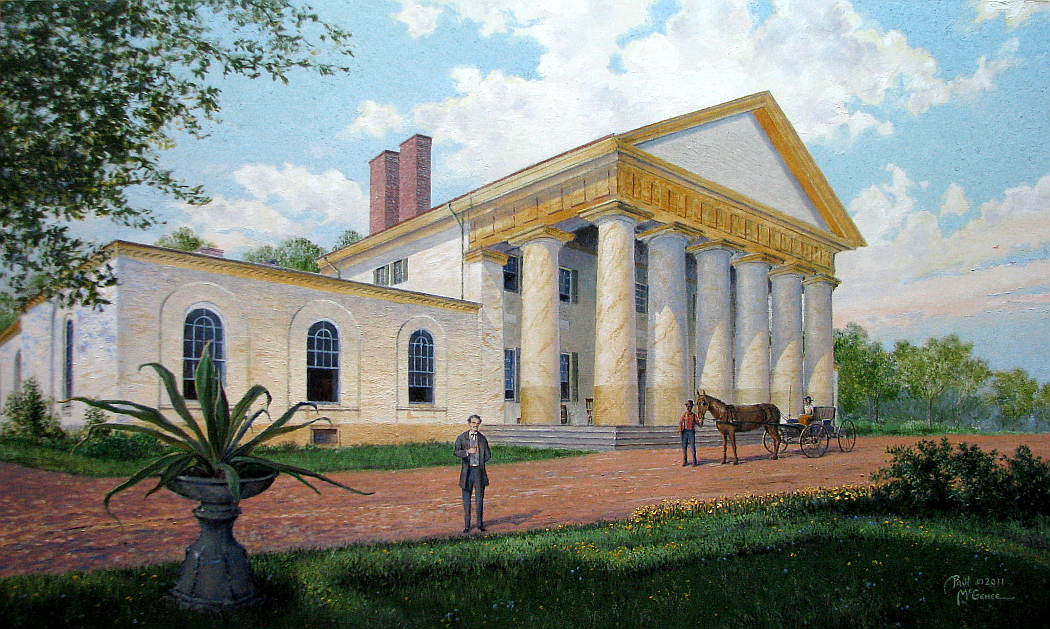
"Arlington
House" by Paul McGehee. Arlington House, also known as the Custis-Lee
Mansion, was built in 1802 as a living monument to the memory of our
first President, George Washington who had died just 3 years before. It
was built by Washington's adopted grandson, George Washington Parke
Custis, the son of John Parke Custis, Martha Washington's son by her
first marriage. Washington's grandson had intended to name the new
mansion "Mount Washington," but the Custis family as a whole decided
upon "Arlington," which had been the name of the old Custis Family
estate in the Tidewater area of Virginia years before. Custis married
in 1804 and he and his wife lived in Arlington House for the rest of
their lives. They had a daughter, Mary, who in 1831 married a childhood
friend (and distant cousin) named Robert E. Lee. Lee, a West Point
graduate working his way up the ranks in the US Army, was the son of
Henry "Light Horse Harry" Lee (George Washington's friend and
Virginia's Governor for 3 terms.) When George Washington Parke Custis
died in 1857, Robert E. Lee became the caretaker of Arlington House. He
maintained its grounds and restored the mansion to its former glory, as
it had fallen into disrepair over the years.
When the
storm-clouds of what was to become the Civil War were forming in 1861,
Lee was offered the command of the Federal Army...but turned it down,
deciding rather to defend his beloved Virginia, which had just
announced that it was seceding from the Union. His fateful decision to
resign from the Federal Army (April 20, 1861) meant leaving his family
and his home to fight on Southern battlefields. On Sunday morning,
April 21st Lee and one of his daughters rode from Arlington House to
Alexandria's Christ Church to attend services...the next morning Lee
was to board a train for Richmond to become a General of the Forces of
the Commonwealth of Virginia. This painting depicts Robert E. Lee in
the foreground enjoying what were to be his final moments at Arlington
House, preparing to ride to Christ Church.
As the
years of
the Civil War raged, Arlington House fell into Union hands, and Lee's
family fled. In 1864, with the number of dead from the battlefield
mounting without sufficient space for proper burial, Union General
Montgomery Meigs took 200 acres of Lee's Arlington House estate grounds
for the purpose of a cemetery. Even after the war ended in 1865, it
continued to grow in size. Arlington National Cemetery, as it was later
named, has become the final resting place for veterans from all
services, and leaders such as President John F. Kennedy. His "eternal
flame" attracts many who wish to honor the fallen President. The Tomb
of the Unknowns is also located at Arlington Cemetery. To this day,
Arlington House (now part of the National Park Service) overlooks the
hallowed ground from high on a hill, with its American flag at
half-staff during burials.